Lean Into Your Hobbies (or We're All Screwed But I Don't Know In Which Way Or What To Do About It)
I'll first note that I recognize my recent stretch of AI articles may have been somewhat tricky to consume. This article will not be technical and will be the last about AI for a bit.
I saw this picture posted on LinkedIn the other day and I think it's somewhat poignant as a starting point for explaining how I feel about the current moment in the rise of AI. What's pictured is matrix multiplication, basically what I've slowly explained over the last four pieces. Don't worry about understanding it if you don't want to, I know the last several pieces have been very technically dense. This won't be. All you need to know is that it's a way of representing the neural network architecture that I've explained already.
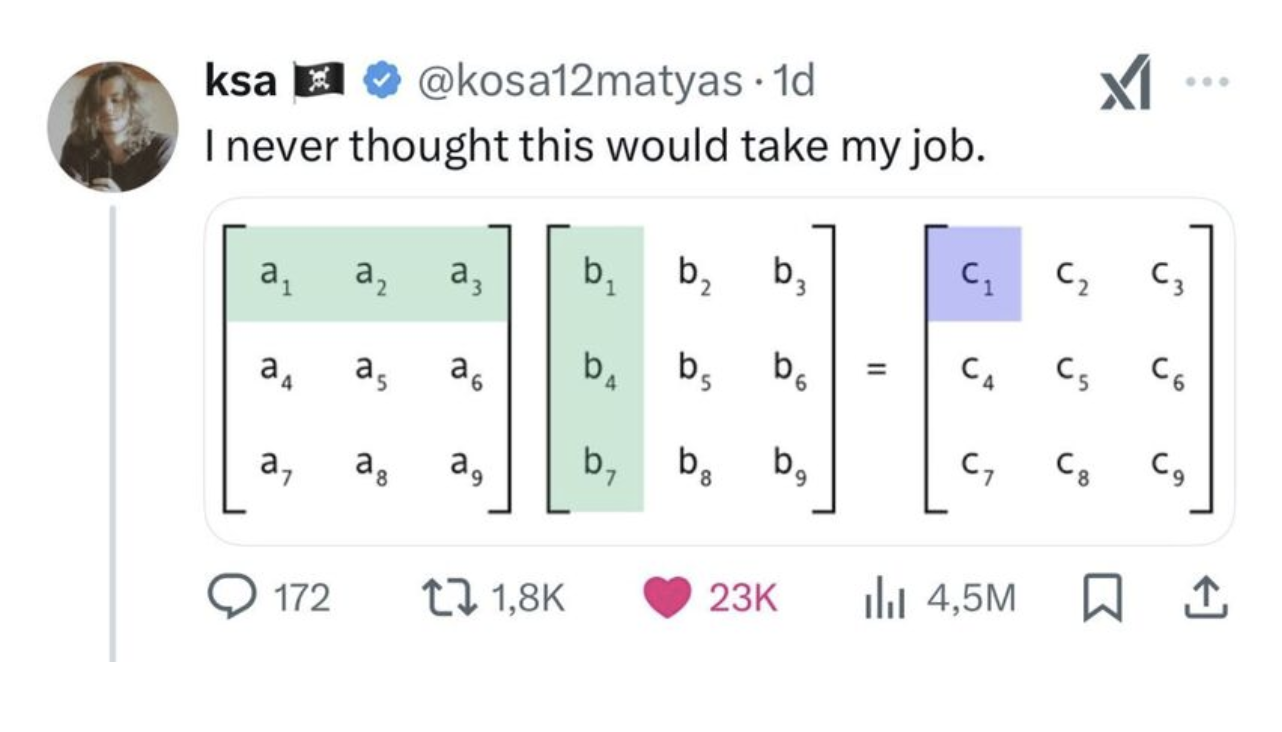
For most of the past six years, I (and many far smarter people in the AI space) have felt like what's pictured above isn't enough. I've had countless conversations around the idea that our current architecture isn't smart enough. We thought it was too random, too naive, that the way humans learn is too different. Smart people cited the massive data input our human brains take in before we take a step and the way we understand the physical world around us as examples of evidence for why ChatGPT and models built on neural networks could only go so far. My boss told me about the differences he saw between the way his child learned and the way the models we used at work learned. ChatGPT was impressive, but it just felt fundamentally unreasonable that this simple idea (let’s connect a bunch of nodes and throw data at it) was enough to crack human level intelligence. There had to be more. And while some leading AI researchers (such as Yann LeCun, former head of AI at Meta) turned away from this simple architecture in favor of alternatives that in their eyes would allow us to make those missing leaps, others shrugged their shoulders and said "we've done pretty well so far, what if we try again, but this time with a few tweaks, more data and more compute?"
The progress made by that strategy - minor tweaks and lots of data and compute thrown at a reliable, if basic, architecture - is unbelievable. I mean that quite literally, as someone that studied this and doubted how far such a naive system could take us. I am routinely shocked by AI progress. I live in this bubble where I see progress every step of the way, and stunning progress continues at a stunning pace. We've already gotten so much further than I ever expected us to get with this architecture, and I don't think the finish line is yet in sight. I almost never code anymore, why would I, when my AI assistant is a better, quicker coder than I am. AI - this series of connected nodes with the incomprehensible amounts of data thrown at it - can write full PhD theses in hours. It can put together reports that companies pay consultancies five figures for in minutes. And it is constantly (and quickly) getting better. One of the interesting (read: scary) points made by this hypothetical AI projection piece is the recursive nature of AI progress. As AI gets better at AI research, the recursive feedback loop speeds up, and current models assist to improve future models, potentially exponentially shortening development times.
I don’t know where this leads. If I had the answers, I’d be sharing them with world leaders instead of with my esteemed readers here on jackspoetic. I don’t know which companies are going to win, what role geopolitics will play, or whether or not a doomsday scenario is on the way. My advice doesn’t hinge on that, because frankly, you can’t plan for any of those things. My advice is rather simple, all things considered: lean into your hobbies. Just that. I think a world in which white collar work is all but gone is possible in the next 10-20 years. I am highly skeptical that myself and my peers will make it to retirement without a drastic shake-up in the way we work (if we work). For much of modern human history, we’ve worried about this. What happens when the jobs go away? We’ve yet to have to answer that question - aside from occasional recessions, month after month, quarter after quarter, the number of jobs just goes up. Saying that, I realize the irony of making the prediction that this time is different. But I do think it's different - I think it’s entirely possible that AI finally changes that, that for the first time in modern human history, the number of jobs semi-permanently decreases. Jobs could drop and not return, not due to a recession, but due to human workers becoming increasingly inefficient by comparison to their AI peers. Productivity overall will continue to increase, wealth will continue to increase, but jobs worked by humans could decrease.
Now how that shakes out is incredibly complicated. What happens when more wealth is created and fewer humans needed. Revolution, war, a complete restructuring of economies and the role of governments, all that is on the table. I'm not going to get into it, and frankly it could get real bad before it gets any better. But ultimately, if we end up in a society in which humans have more time and less need to work, humans will fill that time with human activity. Therefore, my advice is to embrace that human activity. Lean into your hobbies. Join that softball league. Humans will care more about softball. People will watch the Olympics, people will watch the World Cup. I'm sure of that. Take that pottery class. Humans will care more about pottery. Become a better gardener, a better chess player, a better climber - embrace and invest time in your hobbies, because in a world in which humans are less useful workers, more of us, and more of our economy, will be focused on human activities. The better we are at those activities, the more we’ve leaned into our hobbies when we didn’t have to, the better we situate ourselves to stand out in a world where those hobbies are all that’s left for us to do.
One of the biggest reasons I feel comfortable giving this advice is that there isn't downside to being wrong. If I say we're still in the baby steps of the AI economy and therefore you should throw more money into Nvidia and Google and the AI bubble bursts, I've lost you money. If I tell you to ignore your career development and travel because we'll all be on UBI in 10 years and I'm wrong, you've harmed your career. But if I tell you to learn to knit and AI never replaces white collar workers at scale, at least you've learned how to knit. So learn how to knit, and practice your juggling skills. It may be all we have left. And if it's not, at least you're a better juggler.
Thanks for reading!
Comments
Loading comments...