A Spanish World Cup in Barcelona
I started my Sunday fairly late, meeting up with some friends in a nearby park for some chess and a coffee. As the games continued and the coffee turned to vermut and there were just three of us left, I vented a little on my frustrations regarding taking in a World Cup in Catalunya. It was myself, a Colombian friend (who recently got his Spanish passport after 9 years in the country), and a Catalan friend. In Catalunya, it’s always a bit complicated rooting for Spain. I shared how much I love the simple, shameless sensation of getting excited about sports, and how cheering for your country is a special kind of fandom. From Michael Phelps and his 8 gold medals, to Megan Rapinoe with her arms stretched wide, to Steph Curry’s heroics in Paris two summers ago, for as long as I remember it’s been easy and fun to get excited about rooting for your nation. Here, it’s not that easy.
A Catalan friend of mine, the day of the match, posted a photo he had taken as a kid with Messi, with the caption “confiem amb tu, @leomessi” - “we trust in you”, written in Catalan of course. This mindset is not uncommon in Catalunya. I remember this same friend, who was in many ways my introduction to how Catalans feel about Spain, actively rooting against the Spanish national team in the 2021 Euros. I remember the verbal abuse hurled at Maria as we watched the final of 2024 Euros at a bar by a drunk Catalan insulting her for her Spanish jersey. I asked Carles, one of Maria’s closest friends, “Somos todos con la Roja?” “Are we all supporting the national team?”, and he told me “Me la pela la Roja”, “I couldn’t care less about the national team.”
As I played through the Spanish opening (of course) with the white pieces, I complained to my friends. I told them that perhaps Carles is right to some extent. Carles had told me that if I were in Catalunya in 2017, if I was there on October 1st when Carles and his friends stood guard to protect Catalans’ right to vote on independence, if I was there when Spain sent thousands of police officers to violently suppress that right to vote, that I would feel differently. But I wasn’t here then, and I hadn’t seen the height of the independence movement. And my point of reference, my tunnel into the culture, Maria, was so firmly set in both worlds that it felt hard to so cleanly separate them. Maria identifies as more Catalan than Spanish, and that will never change. But she also, like millions of other Catalans, has deep connections to the rest of Spain. Her grandparents, on both sides, immigrated from other parts of Spain to Catalunya. In 1999, it was estimated that 60% of Catalans immigrated from other parts of Spain in the last century. That percentage has only grown since then. My Catalan friend across the board was no different - his preferred language is Catalan, hell his name is Guillem, but his grandparents are originally from Andalusia. I think politics and history aside, I selfishly wanted that simple joy of being able to shamelessly support a fun and talented team with everyone around me.
I got that to a greater extent than I expected. We showed up at the bar we had reserved for the night with some apprehension, half expecting to be surrounded by Argentinians or Catalans supporting Argentina. Instead, the bar was packed with Spain jerseys. A small Spanish flag waved out front, and for the full 90 minutes, and all of extra time, the whole bar was in unison, there to support their national team. Argentina’s antics certainly made it easier - their disruptive play style frustrated and animated those around me and raised the collective energy. There was a growing feeling among those around me, both over the course of the tournament and over the course of the night, that we were cheering for the good guys against the bad guys. I know that sounds reductive, my side good their side bad, and it’s obviously not that simple. But Spain’s biggest star, Lamine Yamal, comes from a poor neighborhood outside of Barcelona, born to a Moroccan father and Equitorial Guinean mother, speaks fluent Catalan, and waved the Palestine flag at Barça’s parade last year. Spain’s biggest celebrity fan, Javier Bardem, has been non-stop posting about “A Spain in which we all belong”, relentlessly progressive, inclusive, and pro-Palestine. Argentina’s biggest non-Messi star Enzo Fernandez, who fittingly got sent off with a red card, is most famous for live-streaming racist chants after Argentina’s Copa America victory a few years back. Their team has had its fair share of calls go their way over the course of the tournament, building a somewhat unprecedented level of resentment. After what our crowd thought was a game winning goal was called off for a mystery foul, the shouts from the bar against Netanyahu, against Trump, against FIFA came ringing from the bar around me. Conspiracy theories, yes, drunken bar banter, yes, but there was a building sense that it wasn’t just Spain against Argentina, it was good football against bad, Trump’s enemy Pedro Sanchez against Trump’s friend Javier Milei, Palestine against Israel. The stress built as Spain couldn’t find an end product. It was all too on-the-nose when Spain’s second game winner, celebrated in the corner by Ferran Torres, was framed by an Argentinian fan just above waving the Israeli flag just above the players’ heads. The bar went nuts, everyone there, united, cheering on our team, as I had hoped for. And after we suffered through a few tense moments as Argentina, for the first time all game, had some pressure of their own, the crowd went bonkers as the full time whistle blew. Spain, champions of the world. Toni Kroos tweeted out two words: “Football won.”
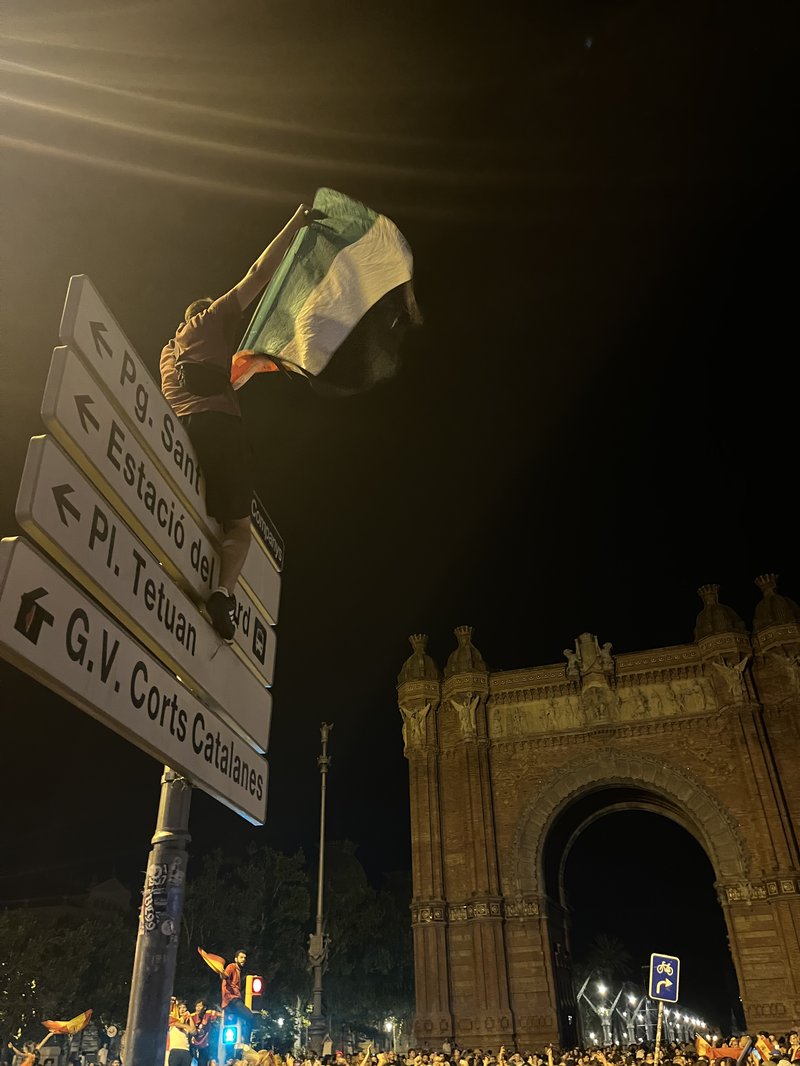
My group of friends, all of whom would identify as more Catalan than Spanish, all of whom’s preferred language is Catalan, had raucously celebrated Spain’s victory in the bar. All wanted to join the celebrations at Arc de Triomf. But as we drew close to the noisy crowd, filled with flags, flares, and fireworks, there was also clearly some level of tension with the public celebrations. Maria proudly wore her Spanish jersey, purchased by her parents as a gift shortly after Spain’s 2010 World Cup victory. But she also views those brandishing and waving the Spanish flag as a step too far. To own and to display the Spanish flag here in Catalunya, in her eyes, is an act of nationalism more extreme, and less forgivable, than wearing a shirt to support the team. Our friends also clearly drew the line at some chants. They were happy to join in and sing “Campeones, Campeones”, happy to chant “who doesn’t jump is Argentine.” But the chants of “ES-PAN-YA”, and “Yo soy Espanyol, Espanyol, Espanyol” clearly made them uncomfortable. There was a slight uneasiness in the air, a weird sensation seeing these Spanish flags so proudly brandished in the heart of Catalunya. They were, to a person, ecstatic that Spain had won, but clearly felt unease at taking part in what felt like a nationalist rally in the heart of a territory that fiercely fought for its independence from that nation. Maria and her friends were all too aware of the political mindset potentially lying underneath those celebrations, all too aware of the way those chants and those symbols had been used to oppress. It was perhaps unsurprising that the loudest cheers of the night from our group came when a Palestine flag, rather than a Spanish one, was waved by one of the many fans that climbed to the top of a nearby street sign. It was easier, more universal, less guilt-free, to shout “Free Palestine” than it was to brazenly root on the nation with such a complicated history. A little after 1 AM, we headed home, still shocked by the sheer number of people in the streets. “Who knew there were so many Spaniards in Barcelona” we kept commenting, as we passed more and more people descending on Arc de Triomf.
I love asking people from different parts of the world about their personal sense of identity. I love finding out which aspects of their geography make them proudest. I could identify as a North Carolinian, as a southerner, as an American, and I could draw from those geographical entities bits and pieces that help make me who I am. I’ve asked Russians and Ukranians, Germans and French. If you asked Maria, and many of her friends, what piece of their identity resonates most strongly, “Spanish” would be far down on the list. I think for one night, that Spanish identity felt ever-so-slightly easier to embrace.
Thanks for reading!
Comments
Loading comments...