Time Under Tension
One brief note before I start. Perhaps you've heard the linguistic argument that there's no such thing as a true translation. I subscribe to that idea. Bueno means good, but there are situations where you would use bueno where you wouldn't use good, and vice versa. It's a strange feeling when a word in one language is more fully useful and descriptive in a particular situation than any you can come up with in your own language. That is all to say, writing this piece, publishing it, I feel a bit pesado. Now pesado most literally translates to heavy, and does mean that in some contexts. But it also can mean tiring, tedious, annoying, "oh not this again". And when I write this piece I can't help but imagine my little sister rolling her eyes thinking "Que pesado, here goes AI boy talking about AI again, giving me advice again." Pero bueno, es lo que hay.
AI has come faster for my work than it has for most people. My job is many things, but first and foremost, I produce code. And writing code is one of the things AI does best. I don't write code anymore. In 2022, I wrote all my code. In 2023 and 2024 I started to occasionally ask ChatGPT for help when I had a particularly challenging bit of code to write that I couldn't figure out on my own, but for the most part I wrote my own code. I remember living in Fort Collins in 2023, working from coffee shops, and going for walks around the block just to clear my mind and try to think through a solution when I would encounter a particularly difficult problem. I remember reveling in the novelty of being able to throw those particularly difficult problems to an intelligent assistant, and the ease with which it would (occasionally) crack it with an approach I hadn't thought of or didn't know existed. In late 2024 and 2025 I began to use Cursor – Cursor is an AI Coding Assistant that lives inside your IDE.
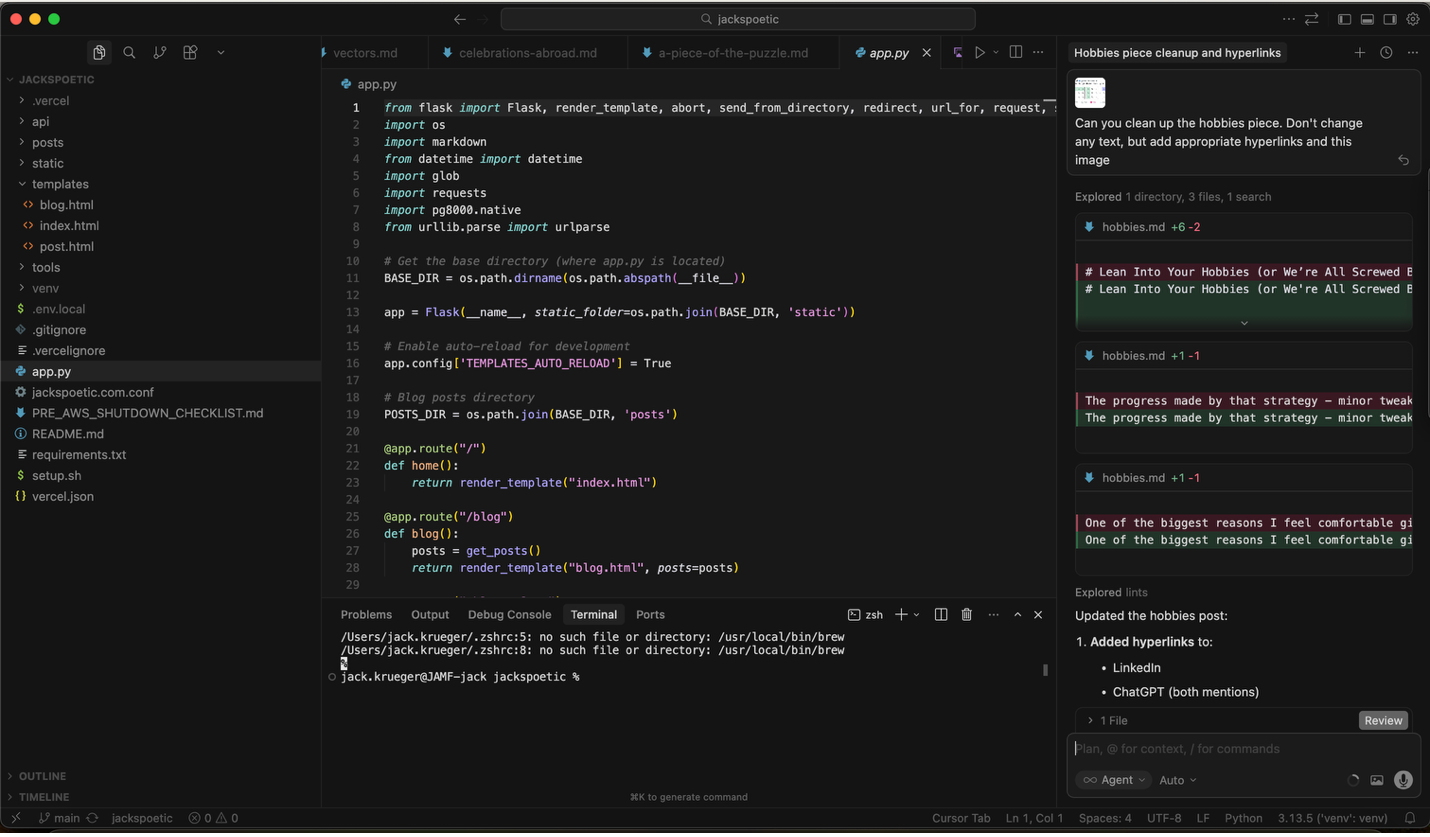
For those unfamiliar, IDE stands for Integrated Development Environment – it's basically just the software program someone who writes code uses to interact with their code. AI "living inside" of a codebase was a big jump. Instead of cumbersomely copying and pasting specific sections back and forth with ChatGPT, the AI assistant now had full access to my code – I could ask a question and the AI assistant could search through the codebase and find the answer, understanding all of the interactions and underlying dependencies rather than relying on the limited information I could paste into a chat context window. I spent most of my time interacting with the AI assistant (the rightmost tab in the screenshot above, you can see an example of a task I'd ask AI to do rather than doing it myself), but I was still present in my codebases, reading and reviewing proposed changes, advising when the proposed solutions were overly complex or incorrect. Today, in 2026, I almost exclusively use Claude Code, where I am interacting with an AI Coding assistant via my terminal. While Claude Code will still ask for approval on changes, I no longer am actively present in my codebase.1
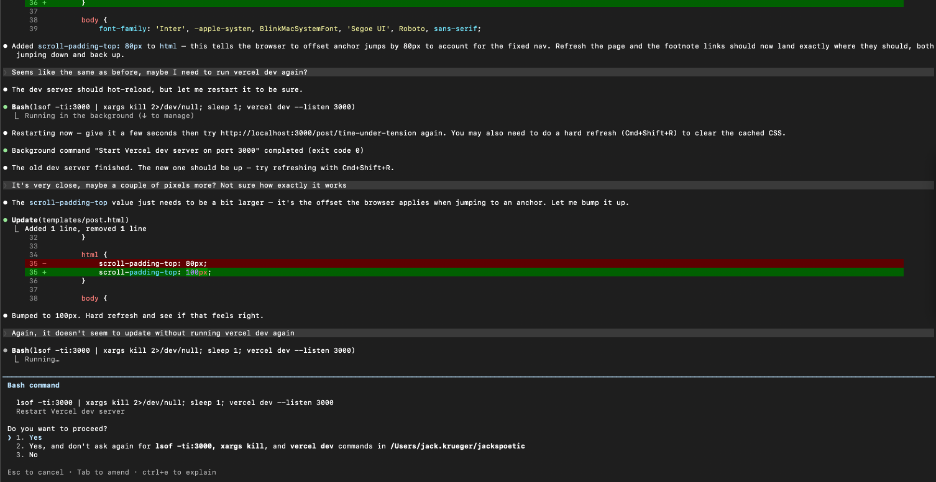
First and foremost, I am chatting, in natural language, with Claude. I don't write code, I hardly see code. I approve or disapprove of the decisions made by Claude – I guide it, as a manager would guide a junior developer. I tell it when it has overlooked something, when it needs to explore a different approach. These tasks are still engaging - I really enjoy working with Claude. The other day, while watching basketball, I built a chess bot that mimicked my playing style – it learned from my games to play moves that I would make. I learned about how chess engines work, how to play with the balance between the best possible move and the most "me" move. Claude taught me a new word – quiescence, and I learned that chess engines contain a feature called a "quiescence search" – even if it is set to calculate only 10 moves deep, it doesn't end it's calculations with pieces still hanging, captures still possible, etc. It waits until the position is quiescent to finish it's calculations. Claude is a useful and enjoyable tool.
But it has made my life easier. I no longer take a walk around the block to figure out how to tackle a particularly difficult problem. I didn't have to write a single line of code to create a chess bot. My mind spends less time under tension, because I no longer do many of the "hard" tasks previously associated with my job.
That's an incredibly long-winded way of getting to my main point – the value and necessity of continuing to put our minds under tension. I was talking with my friend Sean at some point recently about a questionnaire we were putting together to prepare our speech at a friend's wedding. He joked that he froze up when trying to phrase a question, that the thought crossed his mind to ask ChatGPT to write the question for him. As traditional "hard" tasks become automated, we need to find ways to let our minds keep practicing.
Our muscles get stronger, stay strong, when we expose them to time under tension. Without this, they atrophy. Our minds need the same. It's one of the things I've enjoyed most about this blog. I know my writing isn't great. I know my editor dad cringes with every run-on sentence, misspelling, and grammar mistake. It's self-indulgent and presumptuous – but it's also very much mine. In a time when the presence of the em-dash in the sentence above sets off alarm bells in people's heads that I'm using AI to write, I'm proud that I'm very much not. I've always been fond of the em-dash, and I'm absolutely writing in my style, whatever that may be. I'm putting my mind through time under tension, forcing myself to formulate my thoughts into a structure, going back and editing them, polishing them, finalizing them in order to share with my friends and family. It's "hard" in the sense that it takes brain power, and there is value in that.
I just finished competing in the Lliga Catalana d'Escacs. The Catalan Chess League. Every Sunday, from mid-January, to mid-March, I woke up early and sat in front of a chess board for 4-5 hours. I would play one match, against one opponent, and in the end either gain 0, .5, or 1 point for my team. Over the course of those 4-5 hours, my mind would not stop. In shorter time controls, chess is a lot about pattern recognition and intuition. Online, I often play 3 minute games – each side has 3 total minutes to complete all of their moves. If your time runs out, you lose. In that format, I often play 10 or so moves in the first 10 seconds that I'm familiar with, and then rely heavily on instinct to finish the game. This knight looks good on this square. This pawn break seems to open the board in a favorable way. There are mini-calculations along the way – he takes my pawn, I take his knight, he takes my bishop, I move my rook here.2 But due to the limited time, the most important skills are familiarity, pattern recognition, speed and intuition. In classical (longer) time formats, such as the one we use for the Lliga Catalana, calculation is almost everything. Preparation still plays a role – I study and memorize openings for the first ~5-10 moves, and understand thematic moves related to the resulting structure.3 But for the most part, the game becomes extremely calculation heavy. I am continuously calculating – he does this, I do this, he does that, I do this, he does that, what is the resulting position? Back to the beginning – he does this, I do that, he does this, I could move this here instead, how does he respond? I can spend 15 minutes calculating a line, realize I've missed an alternate move early in the sequence, rule it out entirely, then have to move onto a different option, which also requires thorough calculation. This process is extremely taxing. I finish these matches rabid with hunger and exhausted, even though all I've done is sit. It's the best example I've got of time under tension. So here I am - pesado with my AI advice again - find ways to put your mind under tension. Do hard things. Read, write, think.
Thanks for reading! One point I forgot to make is the title of this piece is stolen from a podcast called Plain English. My interest level in the podcast has faded, but I can't just be stealing ideas without giving credit.
-
I realized recently that I will be a dinosaur. I have friends a few years younger than me, currently starting in "coding" positions, or graduating with data-oriented masters, who will never learn to code. They won't need to. We have effectively abstracted another layer away. Programmers will only ever use natural language. Younger generations will laugh at me the way I laugh at my father upon realizing he started off writing on a typewriter. ↩
-
I use he here, because it's almost always a he. Chess is extremely male-dominated. My chess club prides itself with having above-average female representation, but women still make up some 10% of our membership. I've played in the Catalan league two years now, and I've yet to face a female opponent. It's a shame and it's a self-reinforcing cycle. Girls that start often don't feel comfortable in these male-dominated spaces and don't continue, thus they continue to be male-dominated. ↩
-
I currently prefer to play the Ruy Lopez with white against e5, and the Alapin against the Sicilian. I play either the Petrov or the King's Indian as black. I would highly recommend all of these openings except the Petrov. The Petrov sucks. It's boring. I play it because you don't have to memorize that many moves to play it well, and you can pretty easily get an equal position out of the opening, but I'm on the hunt for a new opening with black against e4. I would be happy to tell you more about any of these openings. ↩
Comments
Loading comments...